

Additional Information
| Product Name: | SUMO2 Rabbit pAb |
|---|---|
| Catalog No.: | Y3712-20 |
| Also Known As: | SUMO2; HSMT3; SMT3B; SMT3H2; SUMO3; Smt3A |
| Size: | 20 µl |
| Concentration: | See labels on tube |
| Host Species: | Rabbit |
| Isotype: | IgG |
| Reactivity: | Human, Mouse, Rat |
| Immunogen: | Recombinant fusion protein containing a sequence corresponding to amino acids 1-95 of human SUMO2 (NP_008868.3). |
| Swiss Prot. #: | P61956 |
| Calculated MW: | 10 kDa |
| Detected MW: | 17 kDa |
| Applications: | WB (1:500 - 1:2,000) IF (1:50 - 1:200) IP (not tested) IHC (not tested) Note: Antibody dilution should be optimized by users. |
| Purification: | Protein A or G affinity purification |
| Buffer: | PBS with 0.02% sodium azide, 50% glycerol, pH7.3 |
| Storage: | Store at -20℃. Centrifuge to maximize product recovery. |
| PDF Data Sheet: | PDF Datasheet, MSDS |
| Image(s): | (Click image to enlarge) 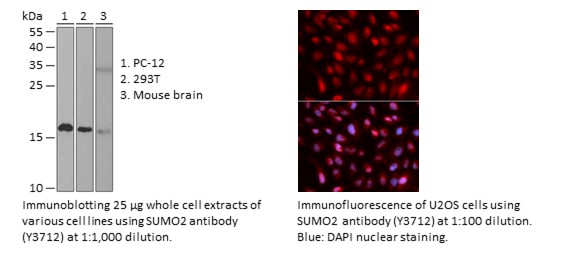 |
| Shipping Method: | Wet ice shipping |
| References: | 1. Kamitani T, et al. (1998) J Biol Chem 273, 11349 - 11353. 2. Su HL, et al. (2002) Gene 296, 65 - 73. 3. Hay RT, (2005) Molecular Cell 18 (1), 1 - 12. |
Details
SUMO2 is a member of the small ubiquitin-related modifier (SUMO) family. There are four confirmed SUMO isoforms in humans: SUMO1, SUMO2, SUMO3 and SUMO4. SUMOylation is a post-translational modification involved in various cellular processes, such as nuclear-cytosolic transport, transcriptional regulation, apoptosis, protein stability, response to stress, and progression through the cell cycle. Polymeric SUMO2 chains are susceptible to polyubiquitination which functions as a signal for proteasomal degradation of modified proteins.

