Terbium-Ubiquitin

A single terbium chelate is covalently labeled on recombinant human ubiquitin (Ub). All lysines, the N-terminal methionine and the C-terminal glycine of Ub are available for ubiquitination. Paring with Fluorescein-Ub (Catalog # T2201), this product has been validated in RELAYTR FRET assays to assess formation of K48 or K63 polyubiquitin chains and autoubiquitination of E3 Ub ligases, in which excellent signal-to-background ratios were achieved.


The assay condition should be optimized to achieve a desirable signal-to-background ratio, including reaction time and concentrations of UbE1, E2, E3, Terbium-Ub and Fluorescein-Ub, A typical range of Terbium-Ub concentration in TR-FRET assays is 10-30 nM, and Fluorescein-Ub concentration is usually 6-15 fold molar excess of Terbium-Ub. UbE1, E2 and E3 concentrations are usually at the range of 10-30 nM, 25-250 nM, 10-250 nM, respectively.


100X RELAYTR Terbium/Fluorescein Ubiquitin Mix (Catalog # T2501) with optimized concentration and ratio of these two Ub moieties were used in all of our RELAYTR ubiquitination assays.


Reaction time is usually 1-3 hours in kinetic or end point assay.

Additional Information

Product Name: Terbium-Ubiquitin
Also Known As: Tb-Ub; Tb-Ubiquitin; Terbium-Ub
Catalog No.: T2001-5
Size: 5 µg
Molecular Weight: 9.5 kDa
Species: Human
Source: Bacterial recombinant
Stock: 20 mM HEPES, pH 7.2, 50 mM NaCl, 2 mM TCEP
Concentration: See tube label
Quality Assurance: ~ 95% by SDS-PAGE; Validated by RELAYTR ubiquitination assays.
Storage: Store at -80°C; avoid multiple freeze-thaw cycles
PDF Data Sheet: PDF Datasheet
NCBI RefSeq: No
Image(s): Images:
(Click image to enlarge)

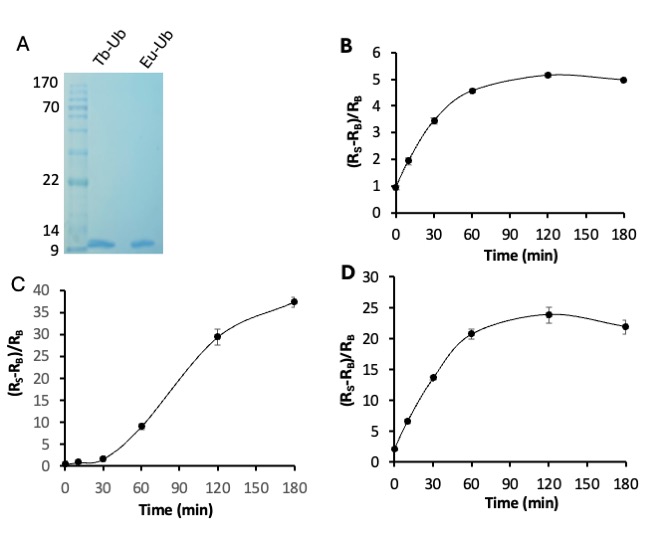
A. Coomassie staind SDS-APAGE with 5 ug Tb-Ub or Eu-Ub.
B. Kinetic mode monitoring 25 nM CHIP autoubiquitination. RELAYTR Terbium/Fluorescein Ubiquitin Mix (Catalog# T2501) was used in all reactions.
C. CHIP concentration-dependent autoubiquitination monitored by RELAYTR FRET assays with Tb-Ub and Fluorescein-Ub. S520/S490 ratios from reactions with ATP were positive Signal (S), and without ATP were Backgrounds (B). The signal-to-backbround ratio was calculated using (S-B)/B.
D. Itch concentration-dependent autoubiquitination, similar to C.

Shipping Method: Dry ice shipping
References: 1. https://www.bmglabtech.com/en/tr-fret/

Details

A single terbium chelate is covalently labeled on recombinant human ubiquitin (Ub). All lysines, the N-terminal methionine and the C-terminal glycine of Ub are available for ubiquitination. Paring with Fluorescein-Ub (Catalog # T2201), this product has been validated in RELAYTR FRET assays to assess formation of K48 or K63 polyubiquitin chains and autoubiquitination of E3 Ub ligases, in which excellent signal-to-background ratios were achieved.
The assay condition should be optimized to achieve a desirable signal-to-background ratio, including reaction time and concentrations of UbE1, E2, E3, Terbium-Ub and Fluorescein-Ub, A typical range of Terbium-Ub concentration in TR-FRET assays is 10-30 nM, and Fluorescein-Ub concentration is usually 6-15 fold molar excess of Terbium-Ub. UbE1, E2 and E3 concentrations are usually at the range of 10-30 nM, 25-250 nM, 10-250 nM, respectively.
100X RELAYTR Terbium/Fluorescein Ubiquitin Mix (Catalog # T2501) with optimized concentration and ratio of these two Ub moieties were used in all of our RELAYTR ubiquitination assays.
Reaction time is usually 1-3 hours in kinetic or end point assay.